Website Design for Detroit Contractors: From Blueprint to Launch
A Detroit contractor with a weak website loses jobs to competitors before the first phone call is ever made. The right contractor website acts like your best salesperson — available 24/7, answering questions, building trust, and pushing qualified leads to your phone. This guide walks through exactly what that looks like, from the pages you need to the local SEO that puts you in front of homeowners and property managers searching right now.
- Most contractor websites fail because they're built for aesthetics, not conversion.
- Five core pages separate a website that ranks from one that doesn't.
- Local SEO for contractors starts with schema markup and service-area pages, not just keywords.
- Speed and mobile optimization are ranking factors — not just user experience perks.
- The build process from kickoff to launch is 2–3 weeks when done right.
Why Most Detroit Contractor Websites Don't Generate Leads
Walk through any neighborhood in Metro Detroit and you'll find contractors with decades of experience, stellar reputations, and full referral pipelines — who are almost completely invisible online. Their websites, if they exist at all, were thrown together in 2018, don't load on mobile, and wouldn't rank for "contractor near me" if they tried.
The result: a homeowner in Grosse Pointe who needs a kitchen remodel searches Google, finds three competitors on the first page, and calls one of them. Your guy with 22 years of experience never gets a shot because he wasn't found.
The most common failure patterns we see in contractor websites:
- No click-to-call button on mobile — If a homeowner on a phone can't tap your number, they move on.
- No service-area pages — Google doesn't know if you serve Warren, Southfield, or Troy unless you say so explicitly.
- Slow load times from unoptimized images — Photos of jobsite work are large files. Uncompressed, they kill your PageSpeed score and your rankings.
- Generic copy that says nothing — "We provide quality contracting services" tells Google and the homeowner absolutely nothing specific.
- No reviews displayed — Trust signals on the page convert visitors who are on the fence. Without them, you're asking strangers to trust you blind.
These aren't cosmetic problems — they're revenue problems. Each one is a reason a qualified lead leaves without calling. The good news: every single one is fixable with a properly built site. See our full breakdown of website design for plumbers and contractors for the technical foundation every trade site needs.
The 5 Pages Every Detroit Contractor Website Needs
A contractor website doesn't need to be large. It needs to be purposeful. Here are the five pages that matter, and what each one has to do:
1. Homepage — First Impression and Trust Builder
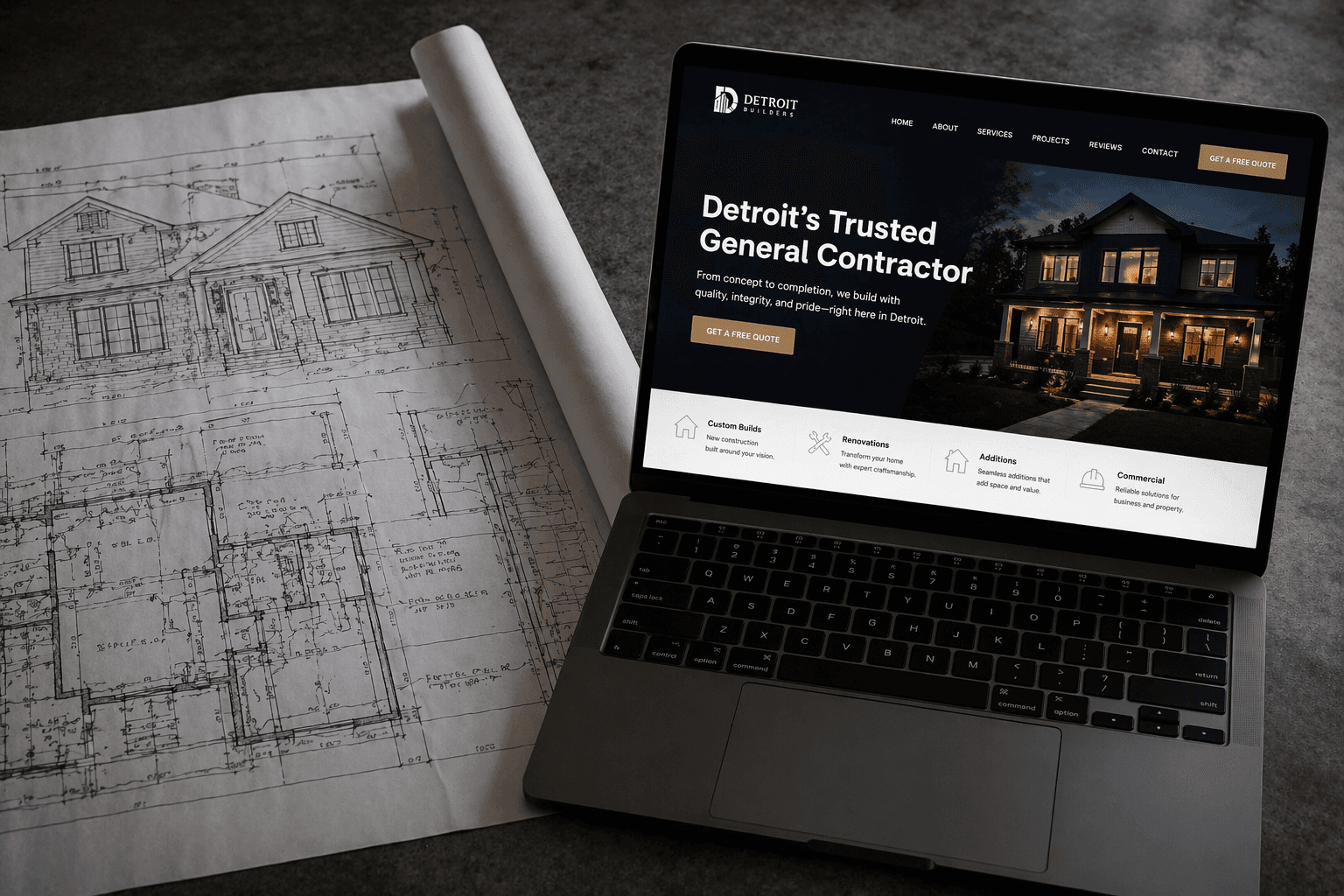
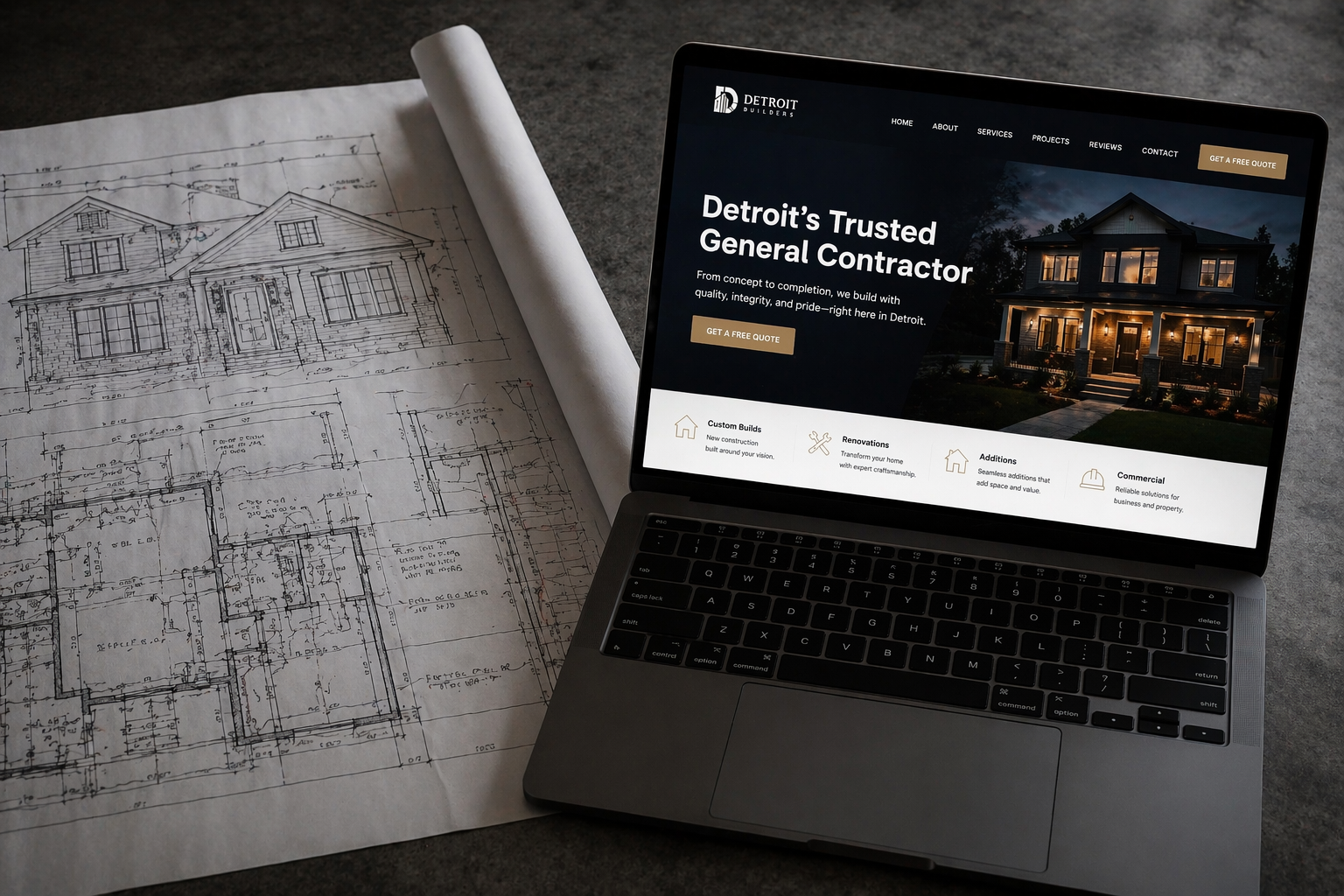
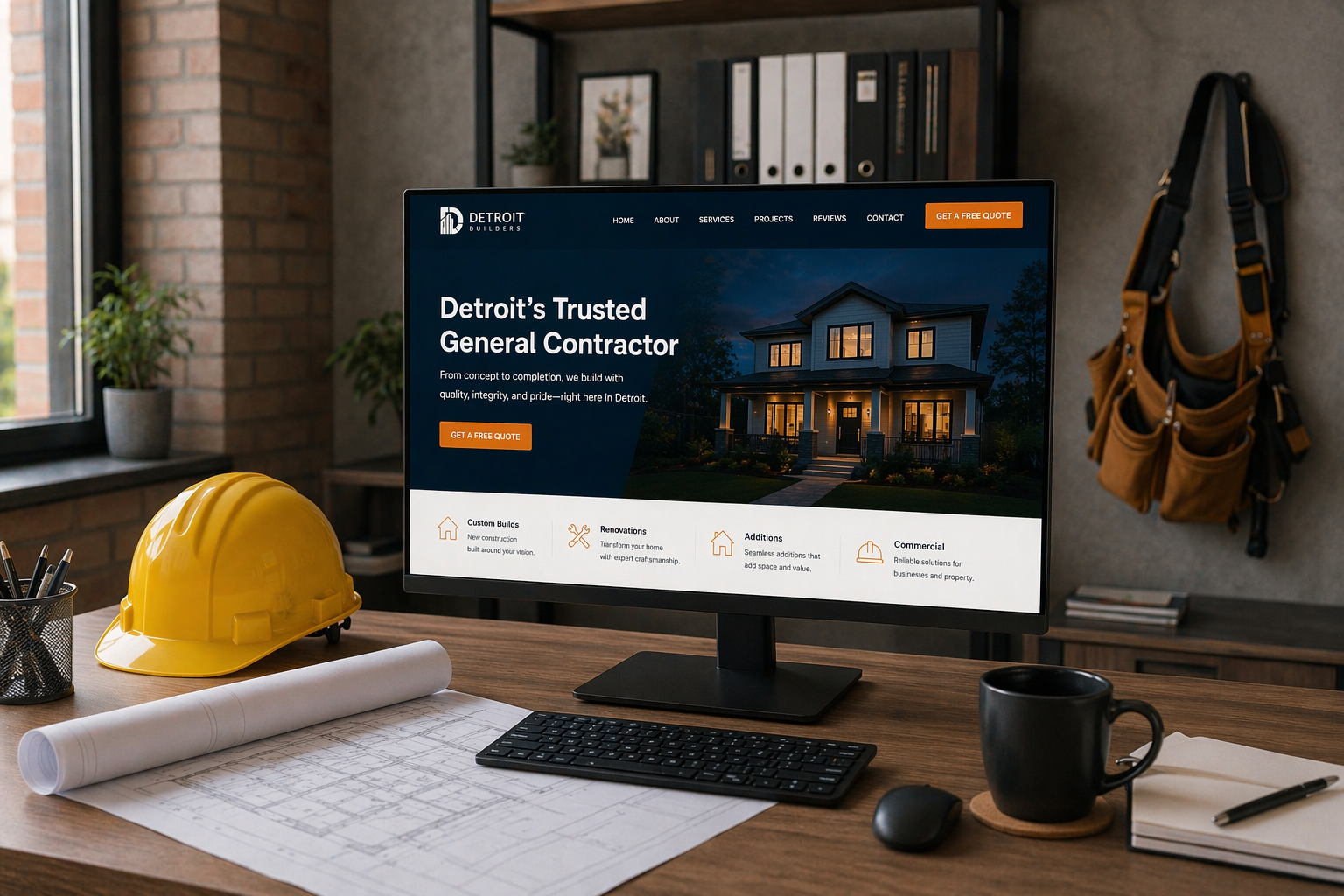
Your homepage is doing two jobs simultaneously: convincing the visitor you're the right contractor, and telling Google what you do and where you do it. The hero section should have your headline (what you do + where), a click-to-call button, and a short summary of your services. Below the fold: a tight services overview, 3–5 Google reviews, and a call to action. No video intros. No animated logos. Speed above all.
2. Services Page (or Per-Service Pages)
One page that lists services is fine for smaller operations. Separate pages per service — kitchen remodeling, bathroom renovation, basement finishing, roofing — is better for SEO because each page can target its own keyword cluster. A roofing contractor in Detroit with a dedicated "Roof Replacement Detroit" page will outrank one whose services are buried in a bullet list on the homepage.
3. Service Area Page (or Pages)
This is where most contractors lose the local SEO game. Google needs explicit geographic signals to surface you for neighborhood- and city-specific searches. A service area page that mentions Detroit, Dearborn, Grosse Pointe, Warren, Sterling Heights, and Royal Oak — with specific context for each, not just a list — tells Google exactly where your business operates. Paired with LocalBusiness schema markup, this is the highest-impact SEO move most contractors never make.
4. Gallery / Project Portfolio Page
Before-and-after photos are the contractor's version of a case study. A homeowner deciding between three contractors will choose the one whose portfolio looks closest to what they want. Optimize every image: compress it, name the file descriptively (detroit-kitchen-remodel-grosse-pointe.jpg), and add alt text that describes the project. These images also rank in Google Image Search and drive additional traffic.
5. Contact Page with Quote Request Form
Your contact page is where leads either convert or evaporate. It needs: a short form (name, phone, service type, brief description), your phone number as a clickable link, your service area, and your business hours. Optional but valuable: a Google Maps embed showing your coverage area. Keep the form short — every additional field drops completion rates. Three fields and a submit button is enough to qualify a lead.
What the Build Process Actually Looks Like
Detroit contractors are busy people. The build process shouldn't require weekly meetings and months of back-and-forth. Here's how a properly run contractor website build goes from kickoff to launch:
| Phase | What Happens | Timeline |
|---|---|---|
| 1. Onboarding | Collect business info, services, service area, photos, and any existing assets | Day 1–2 |
| 2. Copy + Structure | Write all page copy, headlines, meta descriptions, and FAQ content | Day 3–5 |
| 3. Design + Build | Custom Next.js build — no templates, mobile-first, speed-optimized | Day 6–12 |
| 4. SEO Setup | Schema markup, sitemap, robots.txt, Google Search Console connection | Day 13 |
| 5. Review + Launch | Client review, final edits, Lighthouse audit (target: 90+), deploy to Vercel | Day 14–17 |
From signed agreement to live site: typically 2–3 weeks. Faster than most contractors expect, because the process is standardized. The client's main job is answering a short onboarding questionnaire and providing photos. Everything else — copy, structure, SEO, schema — is handled by the studio.
Local SEO for Detroit Contractors: Getting Found Before the Call
Building the site is half the job. The other half is making sure Google understands it well enough to surface it when a homeowner in Southfield searches "general contractor near me" at 7 PM on a Tuesday.
The three technical moves that make the biggest difference for contractor local SEO:
Schema Markup — The Machine-Readable Layer
LocalBusiness schema is structured data code that tells Google your name, address, phone, hours, and service area explicitly — so Google doesn't have to guess. For contractors, adding a Service schema for each trade category (plumbing, electrical, general contracting, roofing) and FAQPage schema for your FAQ content dramatically increases your chances of appearing in rich results and Google's local pack. Most contractor websites have zero schema markup. That's a free competitive advantage for anyone who adds it. Read our complete local SEO guide for the full technical breakdown.
Google Business Profile — Your Second Homepage
For most local service searches, the Google Business Profile appears before any organic results. A fully optimized GBP — with current photos, complete service list, correct hours, and active review responses — is often worth more than the website itself for immediate lead generation. The two work together: your GBP drives discovery, your website drives trust and conversion.
Speed — The Invisible Ranking Factor
A contractor website built on WordPress with a generic theme and unoptimized photos commonly loads in 5–8 seconds on mobile. Google's benchmark for a good LCP (Largest Contentful Paint) is under 2.5 seconds. The performance gap between a slow site and a fast one translates directly into ranking position — and ranking position translates into whether you're in the homeowner's consideration set at all.

The Real Competitive Advantage: Showing Up Before Your Competitors Do
Here's what the market looks like in Metro Detroit right now: most independent contractors have either no website or a neglected one. The contractors dominating local search in their trades — roofing in Grosse Pointe, kitchen remodels in Bloomfield Hills, basement finishing in Troy — aren't necessarily the best at their craft. They're the ones who made the digital investment two years ago and have been compounding their SEO authority ever since.
Domain authority, inbound links, content depth, and review volume all compound over time. The contractor who launches a properly built site today with solid local SEO will have a meaningful ranking advantage over a new competitor who starts in 12 months. The window to build that advantage in Metro Detroit trades is still open — but not forever. Every month without a professional site is a month your ranking gap with established competitors gets wider.
For contractors currently relying entirely on referrals: referral pipelines dry up. Business relationships end. Word-of-mouth is unpredictable. A website is the only lead source that works passively, 24 hours a day, generating calls from homeowners who've never heard of you before. That's not a supplement to referrals — it's an insurance policy against the quarter they slow down.
If you want to understand the investment side of this equation, see our guide to affordable website design for Detroit businesses and the real ROI numbers that come with it.
FAQ: Contractor Website Design in Detroit
How much does a contractor website cost in Detroit?
A professionally built contractor website at a local agency typically runs $2,500–$8,000 for a one-time build, or $197–$397/month on a retainer model that includes hosting, maintenance, and ongoing SEO. The retainer model is usually a better fit for contractors because the site is actively maintained and improved rather than launched and forgotten. A site that underperforms for 24 months costs far more in lost revenue than the build savings suggest. See why cheap websites cost more for the full math.
How long does it take to rank on Google after launching a new contractor website?
Technical improvements — speed, schema markup, mobile optimization — show ranking impact within 30–60 days of Google's re-indexing. Content-driven improvements like service-area pages and blog posts typically take 60–90 days to accumulate ranking signals. Competitive local terms like "roofing contractor Detroit" in a saturated market can take 4–6 months of consistent SEO work. Less-competitive area-specific terms like "contractor Ferndale MI" often rank within 60 days.
Do I need separate pages for each city I serve?
For broad service areas (5+ cities), yes. A dedicated page per major city or sub-region — written with specific local context, not just a city name swapped in — consistently outperforms a single generic service area page. Think "Kitchen Remodeling Grosse Pointe" and "Kitchen Remodeling Warren" as separate pages, each with 300–500 words of specific local content. This is how mid-size contractors compete with larger firms that have bigger ad budgets but weaker organic content.
Can I use my existing photos, or do I need professional photography?
Job site photos taken on a modern smartphone are completely usable — as long as they're compressed before uploading. Raw photos from a phone are 3–8MB each and will tank your page speed. Run them through an image compression tool (or we handle this in the build process) and they perform fine. Professional photography is a meaningful upgrade for portfolio and homepage hero images, but it's not a hard requirement to launch.
What platform should a contractor website be built on?
For performance, SEO, and long-term maintainability, Next.js (React) is the top choice for custom contractor sites. It's faster than WordPress, doesn't require plugins that create security vulnerabilities, and scores consistently well on Core Web Vitals. WordPress with a well-maintained theme is acceptable for contractors who want easy self-editing access. Wix, Squarespace, and GoDaddy Website Builder are not recommended for contractors who want to compete on organic search — the performance ceiling is too low.
Caliber Web Studio builds contractor websites for Metro Detroit trades — mobile-first, speed-optimized, with local SEO and schema markup built in from day one. No templates. No WordPress. No disappearing after launch. Call us at (313) 799-2315, request a free site preview, or see our contractor web design services.
Founder, Caliber Web Studio — Detroit-based web design agency specializing in local business websites for Metro Detroit contractors, tradespeople, and service businesses. Darrin builds every site on Next.js with local SEO and schema markup as standard. Learn more about Caliber Web Studio.