Instagram Can't Fill Tables. Here's What Actually Does.
You've got 2,400 followers. Your food photos get solid engagement. You post the specials every Thursday and your Friday nights stay busy. So why does Wednesday feel like a ghost town — and why are competitors two blocks over consistently packed while you're running promos just to cover labor?
The answer isn't your food. It's your digital footprint — or specifically, the part of it that actually drives new customers. Instagram keeps your existing audience engaged. A website is how strangers find you when they're hungry and searching. Those are two different jobs, and in 2026, Detroit restaurants that only do the first one are leaving real money on the table every single week.
Social Media Is Rented Land
Here's the uncomfortable truth about building your restaurant's online presence on Instagram, Facebook, or TikTok: you own none of it. The platform owns the audience. The algorithm decides who sees your content. Your account can be restricted, shadowbanned, or buried in a feed update overnight — and there is nothing you can do about it.
The Algorithm Can Zero You Out Overnight
In 2023, Instagram changed its algorithm and organic reach for business accounts dropped 40% within weeks. Restaurants that had built their entire customer acquisition strategy around social posts watched their Thursday dinner bookings crater with zero warning. The ones with websites and email lists barely noticed. The ones who'd skipped the website scrambled.
This isn't hypothetical. It has happened multiple times and will happen again. Every platform eventually optimizes for ad revenue over organic reach. When it does, your only defense is owning a channel — a website — that no algorithm can throttle.
Your Instagram Profile Doesn't Rank on Google
Search "best brunch Detroit" or "halal restaurant Dearborn" or "soul food near me." Count how many Instagram profiles appear on the first page. Zero. Google surfaces websites, not social profiles. Every diner who opens Google and searches for exactly what you offer is looking for a website to click — and if you don't have one optimized for that search, you are invisible to them. You could have 10,000 Instagram followers and still not show up for the person who is actively searching to spend money tonight.
Where Detroit Diners Actually Search
The research on how people choose restaurants is clear: 90% of diners research a restaurant online before visiting, and Google is the starting point for most of those searches. Not Yelp. Not Instagram. Not TikTok. Google — and specifically, the map pack results and organic listings that only appear for restaurants with proper websites behind them.
"Restaurants Near Me" — 78% of These Searches Lead to a Visit Within 24 Hours
Near-me searches for restaurants convert faster than almost any other search intent. When someone searches "restaurants near me" or "dinner in Corktown Detroit" or "Lebanese restaurant Dearborn," they've already decided to go out. They're choosing where — and that choice gets made based on what they find in the next 60 seconds. A restaurant with a fast, well-designed website showing their menu, hours, and location wins that moment. A restaurant with only an Instagram profile loses it to a competitor who has a website.
The Three-Second Decision Window
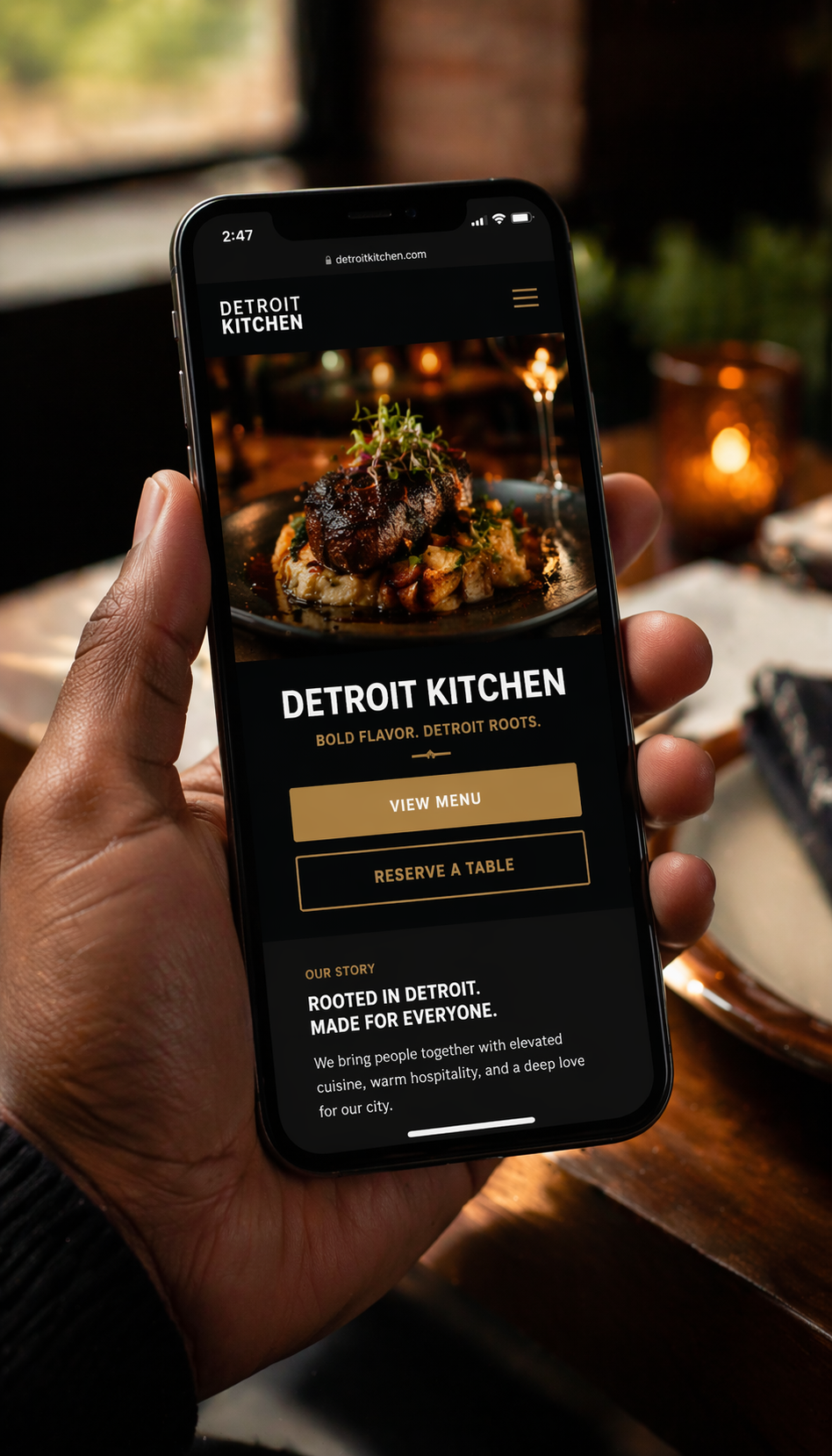
When a potential diner lands on your website, they make a judgment call in under three seconds: Is this the vibe I want? Can I see the menu? Can I get a table? If your site answers those three questions immediately, you get the cover. If it's slow, confusing, or requires three clicks to find the menu — or worse, if you have no website at all — they click back and go to the next result. That decision happens hundreds of times a day. Every one of those losses is invisible to you because the diner never arrived.
What a Custom Restaurant Website Does That Instagram Can't
Your Menu, Your Rules
Your menu is your most important sales tool. When it lives on your website as a real HTML page — with descriptions, prices, and dietary callouts — it becomes searchable. Someone searching "lamb shank restaurant Detroit" or "gluten-free brunch Eastern Market" can find you because your menu content is indexed by Google. When your menu is a PDF, an image, or a link to a third-party app, it doesn't exist in search. You're invisible to every customer who searches for exactly what you serve.
Build your menu as a properly structured web page. Not a PDF. Not an embedded image. An actual HTML page that Google can read, that loads in under two seconds on mobile, and that a food-allergic diner can search for their specific dietary need. That's what good restaurant website design actually requires.
Online Reservations That Don't Require a Phone Call
Most people — especially the under-40 diners filling Detroit's food scene right now — will not call to make a reservation. If you require a phone call to book, you're losing the customer who's browsing at 10 PM when your host stand is closed. An embedded reservation system (OpenTable, Resy, or Square) on your website captures bookings around the clock. No phone required. No missed call, no voicemail, no lost cover. You wake up Tuesday morning with Wednesday reservations already on the books.
Direct Ordering — Keep the 30% You're Giving Away
If you offer takeout or delivery, here's a number that should bother you: DoorDash, Grubhub, and UberEats take 15–30% of every order placed through their platforms. On a $40 order, that's $6–$12 per transaction going to a tech company that didn't cook the food. An integrated ordering system on your own website — Toast, ChowNow, Square Online — charges a fraction of that in platform fees. Every customer who orders directly through your site instead of a third-party app puts real money back in your pocket. Scaled over hundreds of orders per month, that margin recovery is significant for any Detroit restaurant doing volume.
Restaurant Schema Markup: Show Up in Google's Rich Results
Restaurant schema is structured data embedded in your website code that tells Google exactly what type of business you are, what you serve, your hours, your location, and your rating. Restaurants with proper schema markup show up with rich results — the search listings that include star ratings, price ranges, and cuisine type directly in the results page. Those rich results get dramatically higher click rates than plain text listings. It's a technical advantage your Instagram profile cannot replicate. It only exists on a real website.
The Local SEO Math for Detroit Restaurants
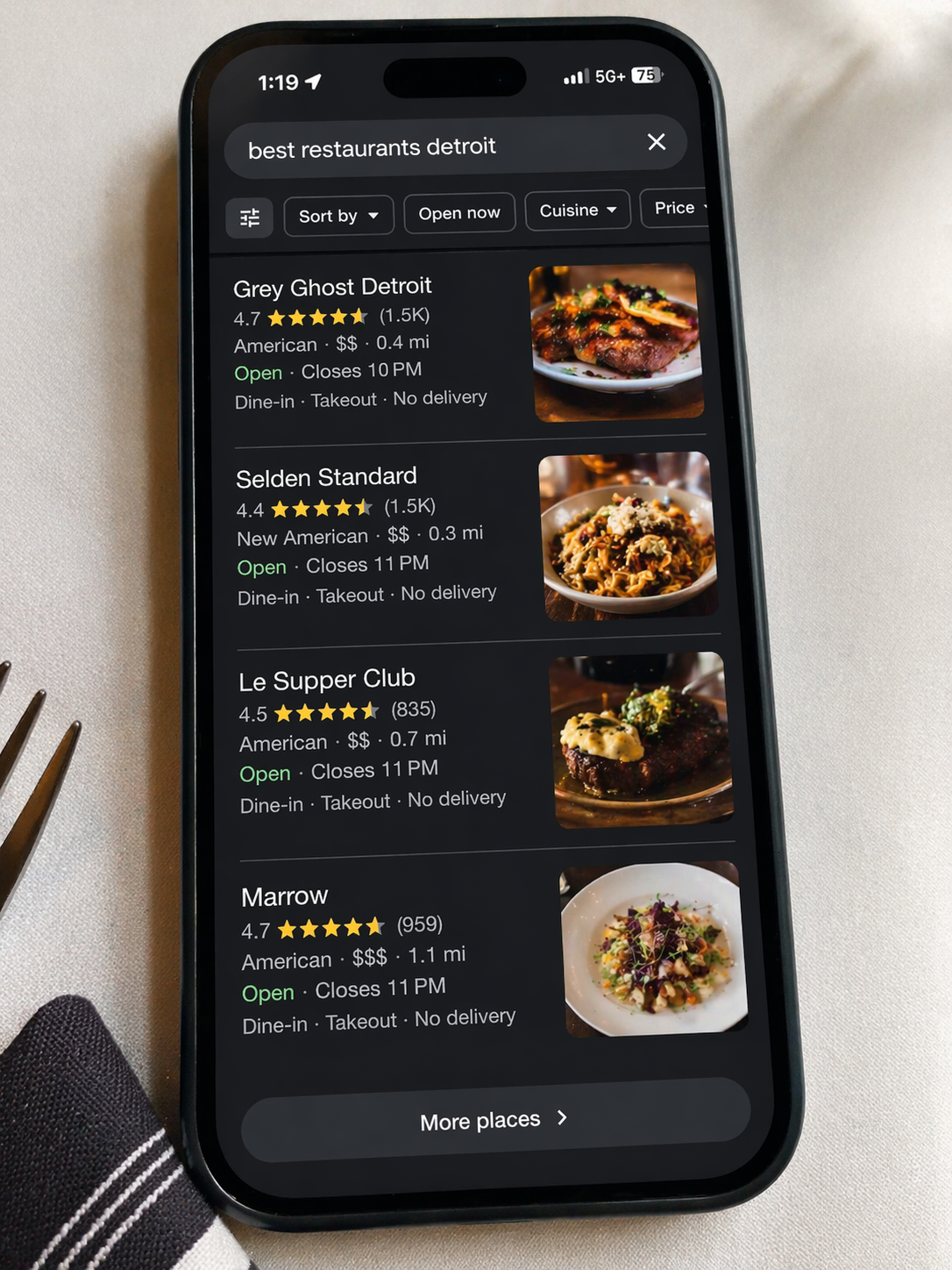
Local SEO for restaurants comes down to one thing: showing up in the map pack and organic results when Detroit diners search for what you serve. The restaurants consistently filling tables from search aren't spending more on ads — they've built a website that gives Google what it needs to rank them.
Your Website + Google Business Profile = Compound Visibility
A fully optimized Google Business Profile without a website is a great storefront with no sign on the door. Your GBP handles map pack presence — the top three results that appear with a map when someone searches "restaurants in [neighborhood]." Your website handles everything else: the organic results below the map, the people searching for specific dishes, the customers doing deeper research before booking. Together, they create compound search visibility. Separately, either one is leaving traffic on the table.
Our Google Business Profile optimization guide covers the full strategy for restaurants — cuisine categories, photo frequency, review generation. But it starts with having a website to link it to.
Neighborhood-Specific Language Wins Local Searches
Detroit diners search hyper-locally. "Best shawarma on Michigan Avenue Dearborn" is a real search that real people make. "Corktown brunch restaurant" gets searched hundreds of times per month. "Eastern Market lunch spot open Saturday" is exactly the kind of query that sends foot traffic to the restaurants showing up for it. A properly built website uses your specific neighborhood, nearby landmarks, and Detroit-specific language throughout — not generic "Detroit restaurant" copy that could describe any spot anywhere. Specificity wins local search. Generic copy doesn't rank.
Why Toast / OpenTable / Yelp Isn't a Substitute
These platforms are useful tools. They are not a substitute for a website. Understanding the difference is critical for any Detroit restaurant owner who wants control over their digital presence.
Third-Party Platforms Own Your Customer Relationship
When a diner reserves through OpenTable, OpenTable captures that customer's data — not you. When they order through DoorDash, DoorDash owns that relationship. When they find you on Yelp, Yelp shows them your competitors on the same page. These platforms don't exist to help you build a loyal customer base. They exist to make themselves indispensable and extract a fee from every transaction. Your website is where you own the email address, build the relationship, and run the retargeting pixel. That infrastructure only exists on your own property.
They're Showing Your Diners Your Competitors
Every third-party platform page for your restaurant is controlled by someone else — and they will display ads for your competitors on it. Yelp's "You might also like" section under your listing is literally a competitor directory. The only digital real estate where you control the entire customer experience — no competitor ads, no distracting links, no algorithm deciding what comes next — is your own website.
The ROI Is Simple — Do the Math
Here's the question to answer honestly: how many extra covers per month does a website need to generate to pay for itself?
Five Tables. That's Your Break-Even.
A Caliber website plan starts at $197/month. If your average check is $45 per person, you need five additional covers per month to break even. Five. One table of two on a Tuesday night that found you through Google, who wouldn't have found you otherwise. That's the entire ROI calculation. Everything above that — the Wednesday reservations, the weekend bookings, the direct online orders bypassing DoorDash — is pure recovered margin.
For most Detroit restaurants doing real volume, a properly optimized website drives 20–50 additional covers per month within the first six months. At $45 average, that's $900–$2,250 in additional monthly revenue against a $197 cost. That's a 4.5x to 11x return — before you factor in the margin you're recovering from direct online orders. The numbers for Detroit small businesses consistently show this. Restaurants aren't an exception.
What a Detroit Restaurant Website Must Include
- Full HTML menu pages with descriptions, prices, and dietary callouts — no PDFs, no images, no third-party embeds
- Mobile-first design — 85% of restaurant searches happen on phones; if your site doesn't work on a 375px screen, you're losing those covers
- Embedded reservation system — not just a link to OpenTable, but a booking widget directly in the page
- Direct online ordering for takeout and delivery — keep your margin instead of paying platform commissions
- Restaurant schema markup for Google rich results — star ratings, price range, cuisine type, and hours in the search listing itself
- Neighborhood-specific language — your actual Detroit neighborhood, nearby landmarks, the specific cuisine identifiers your community uses
- Professional food photography — real photos, not stock. Diners decide with their eyes before they ever walk in.
- Google reviews integration — your star rating and recent reviews visible directly on the site
- Hours and address on every page — the most searched information and the most commonly buried
- Sub-2-second load time — page speed is a direct Google ranking factor and a direct conversion factor
Why the Cheap Website Is the Most Expensive Decision You Make
Detroit restaurant owners who've tried Wix, Squarespace, or a $500 freelancer build know the pattern: you get something that looks passable but doesn't rank, loads slowly on mobile, and has none of the local SEO infrastructure needed to compete in search. You spent money and got a digital brochure nobody can find. The cover cost was small. The ongoing cost in lost customers is not.
A custom restaurant website built for local search performance is a different product entirely. Not just aesthetics — technical architecture. Schema markup baked in from day one, page speed optimized, mobile-first layout, location signals embedded throughout the content, menu structured for Google indexing. That infrastructure is what produces the covers. Our breakdown of local SEO for small businesses covers what it actually takes to rank — and why cutting corners at the build stage costs three times as much to fix later.
What Caliber Web Studio Builds for Detroit Restaurants
Caliber Web Studio builds custom restaurant websites for the Detroit metro area. No templates. No WordPress drag-and-drop. No offshore development. Every site starts with your neighborhood, your menu, your customer base — and builds from there.
A Caliber restaurant website includes full HTML menu pages with schema markup, embedded reservation and ordering systems, professional photography integration, local SEO targeting your specific Detroit neighborhood, Google Business Profile optimization, and a mobile-first design built to convert the diner who finds you at 9 PM on their phone. Plans start at $197/month with $0 down.
If your restaurant isn't showing up in local search the way it should, call us at (313) 799-2315 and we'll show you exactly what's holding you back — no pitch, just a straight answer.
See what a custom Detroit restaurant website looks like before you commit. Get a free site preview or call (313) 799-2315 — we'll build it around your neighborhood, your menu, and your customers.