
How Detroit Mechanics Are Getting Found Online With Better Websites
Detroit auto repair shops with better websites are consistently outranking shops with decades more experience — because when someone searches "auto repair near me" at 7 AM with a check engine light on, the shop that shows up first gets the call. In 2026, that means having a fast, mobile-optimized website that ranks for auto repair website design Detroit searches and converts visitors into booked appointments before they click away.
- Over 80% of people search online before choosing an auto repair shop
- A shop that doesn't rank on the first page of Google is functionally invisible to new customers
- Click-to-call, Google reviews, and service pages are the three highest-ROI website features for mechanics
- Speed and mobile performance are ranking factors — a slow site loses business directly to faster competitors
- Schema markup and Google Business Profile optimization are what separate shops that dominate local search from those that don't show up at all
Why Detroit Mechanics Are Losing Customers Before the Phone Rings
Independent auto repair shops in Detroit have a trust advantage that franchise chains can never replicate — long-term relationships, community roots, and real accountability. The problem is that trust doesn't matter if the customer never finds you.
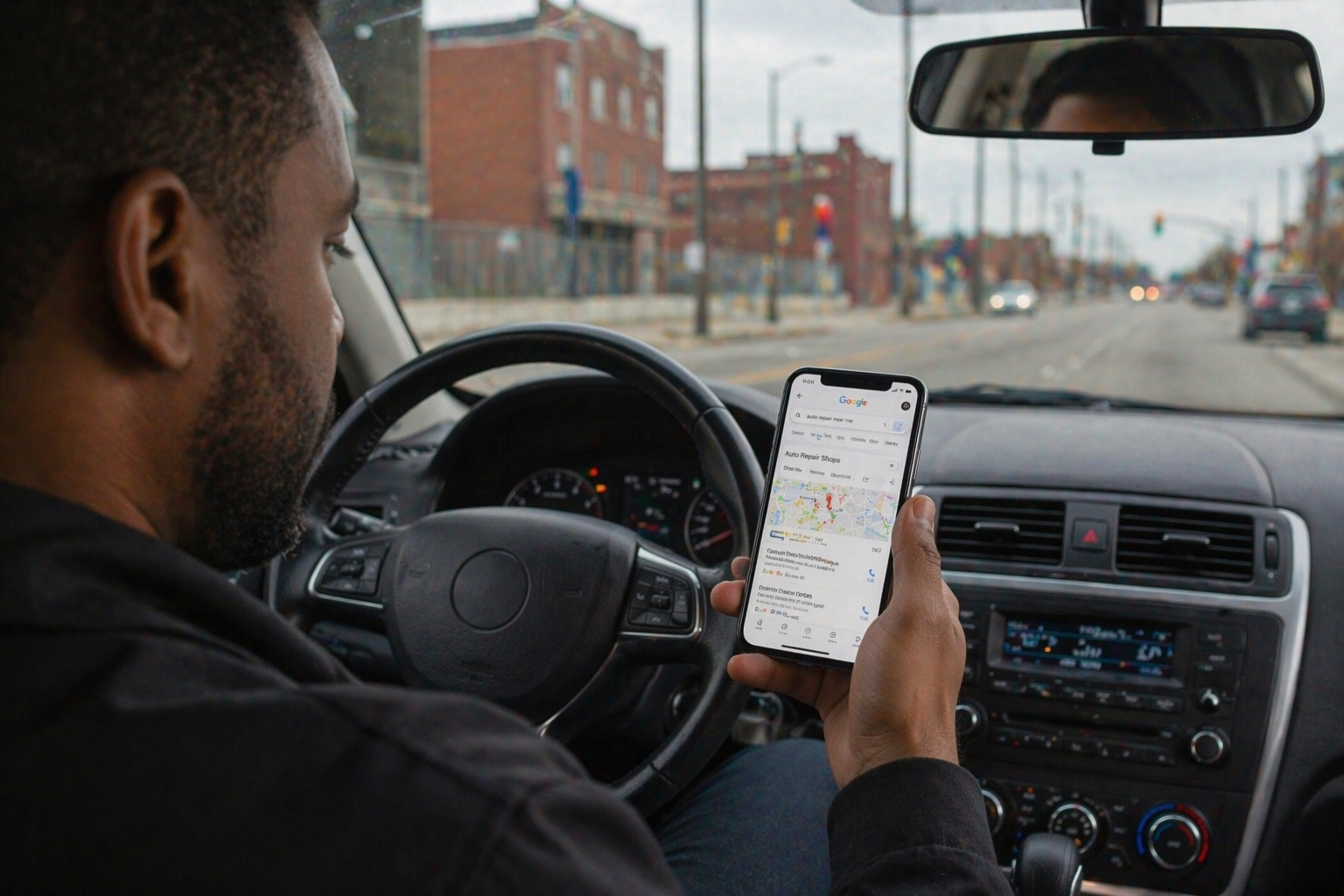
The search behavior is unambiguous: when someone's car starts making a noise they don't recognize, or their brake light flickers on at 6 AM before work, they reach for their phone. They search "auto repair near me" or "check engine light Detroit" or "brake repair Dearborn." Google returns a map pack — three shops with photos, star ratings, hours, and website links. The customer taps the first result that looks legit and calls.
If your shop isn't in that map pack, or your website looks like it was built in 2012, or it takes five seconds to load on a phone — you don't get that call. Your competitor does. This is happening hundreds of times per month in every Detroit zip code, and most shop owners have no idea how many customers they're losing before the first ring.
The mechanics who figured this out early are quietly dominating their local markets. The ones who haven't are wondering why foot traffic is flat despite doing great work.
What a High-Performing Auto Repair Website Actually Looks Like
There's a wide gap between having a website and having a website that works. Most auto shops in Detroit have the former. Here's what the latter looks like — the features that separate shops getting 40+ organic leads per month from shops getting 4.
A Mobile-First Design That Loads in Under 2 Seconds
The majority of local service searches happen on mobile. Someone broken down on I-94 is not pulling out a laptop. They're on a cracked iPhone in a tow truck, trying to find a shop that can see them today. If your site takes four seconds to load or looks broken on a small screen, that customer has already bounced to the next result.
Google also uses Core Web Vitals — load speed, visual stability, and responsiveness — as direct ranking factors. A slow site doesn't just frustrate customers; it ranks lower than a fast one, compounding the damage. Modern shops use lean frameworks like Next.js instead of bloated WordPress installs that load twelve plugins before serving a single line of content. The difference in load time is often 3–4 seconds. In search rankings, that difference is measurable. In leads, it's significant.
Click-to-Call Everywhere, Especially on Mobile
This sounds obvious. It's consistently the most-neglected feature on auto shop websites.
Your phone number needs to be in the header — large, tappable, no hunting required. It needs to be in the footer. It needs to be in the hero section. And it needs to be in a sticky bar at the bottom of every mobile page so it's reachable no matter how far down someone has scrolled. When someone decides they want to call, the number should be one tap away, not a scroll-and-search expedition.
Auto repair is one of the highest-intent local search categories that exists. The person searching already knows they have a problem and already wants to call someone. Remove every obstacle between that intent and your phone ringing.

Google Reviews: The Ranking Signal Most Shops Underestimate
Google's local map pack isn't random. The three shops that appear when someone searches "auto repair near me" in your area earned those spots through a combination of signals — and Google reviews are one of the most heavily weighted.
Shops with 80+ reviews at a 4.7 average consistently outrank shops with 15 reviews at 4.9. Volume matters alongside rating. Google interprets a high review count as social proof that real customers are finding and using the business — and recent reviews signal that the shop is still active and relevant.
The mechanics who dominate local search have a simple system: they ask every satisfied customer for a Google review before they leave. Not via an email three days later — in person, while the customer is standing at the counter collecting their keys. "Would you mind leaving us a Google review? It really helps the shop." Most people say yes on the spot when asked directly. That conversation, repeated daily, compounds into a review count that competitors can't close the gap on overnight.
Your website should make your Google reviews visible — a widget or pull-through showing your star rating and recent reviews above the fold. This serves double duty: it builds trust with new visitors and signals to Google that your reviews are prominently featured on your own site. Read our guide on how to get more Google reviews without being annoying for a complete system.
Service Pages That Rank for What Customers Actually Search
Having a "Services" page that lists everything your shop does in one paragraph is not local SEO. It's a directory entry.
The shops that rank for specific, high-intent queries have individual pages for each major service: brake repair, oil changes, engine diagnostics, transmission service, tire rotation, AC recharge. Each page targets the specific search terms customers use — "brake repair Detroit," "oil change Dearborn," "check engine light Warren MI" — and answers the questions those customers are actually asking.
| Service | What a weak page does | What a ranking page does |
|---|---|---|
| Brake Repair | Lists it as a bullet point | Dedicated page targeting "brake repair Detroit," answers cost questions, shows reviews |
| Engine Diagnostics | One sentence under general services | Page targeting "check engine light [city]," explains what diagnostics include, has FAQ |
| Oil Change | Generic mention with no pricing | Page with pricing range, service interval info, targets "oil change near me [city]" |
| Transmission Service | Not mentioned at all | Dedicated page, targets high-value "transmission repair Detroit" queries |
Each service page needs the city name woven in naturally, a Google Maps embed, a clear call-to-action (click-to-call or appointment form), and schema markup that tells Google exactly what the page is about. This is the foundation of local SEO for service businesses — and it's what separates shops that get found for specific searches from shops that only rank for their own name.
Google Business Profile: The Ranking Signal Your Website Supports
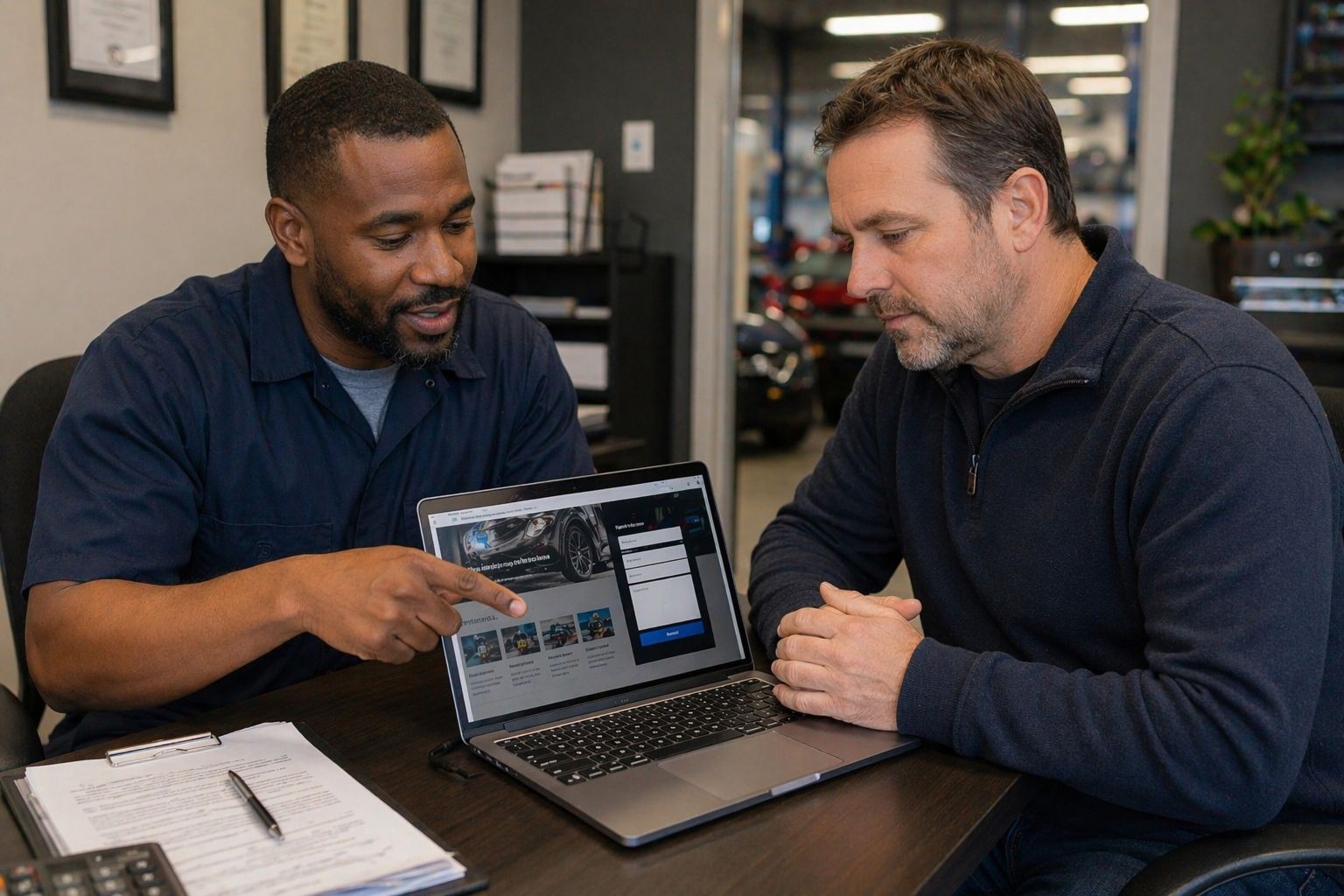
Your Google Business Profile (GBP) is the primary driver of local map pack rankings — but your website is what makes the GBP credible. Google cross-references them. A GBP with a fast, relevant, schema-marked-up website behind it outranks one pointing to a slow generic site.
The mechanics winning local search have GBP profiles that are fully built out: every service category selected, photos added weekly, posts published regularly, questions answered, and every review responded to within 24 hours. The website and GBP work as a system, not two separate assets.
For a complete breakdown of what this looks like in practice, read our guide to Google Business Profile optimization for local businesses. It's the single highest-leverage thing most Detroit shops can do in the next 30 days to improve local visibility.
What Mechanics Actually Get From a Better Website
Here's a concrete example of what a website rebuild typically produces for an independent auto shop in Metro Detroit.
A shop in Warren was ranking on page three for their primary search terms. Their site was a 2019 WordPress build that scored 41 on Google's PageSpeed Insights for mobile. They had 22 Google reviews. New customers from organic search: roughly 8 per month.
After a rebuild — Next.js framework, service-specific landing pages, schema markup, mobile performance score above 90, and a GBP optimization alongside it — the outcomes over four months: ranking in the map pack for "auto repair Warren MI" and three related service terms, 94 Google reviews, and new customers from organic search averaging 35 per month.
That's not from a marketing budget. It's from fixing the digital foundation. The shop was already doing excellent work. The website finally reflected that to the people searching for it.
The Trust Signals That Convert Visitors Into Callers
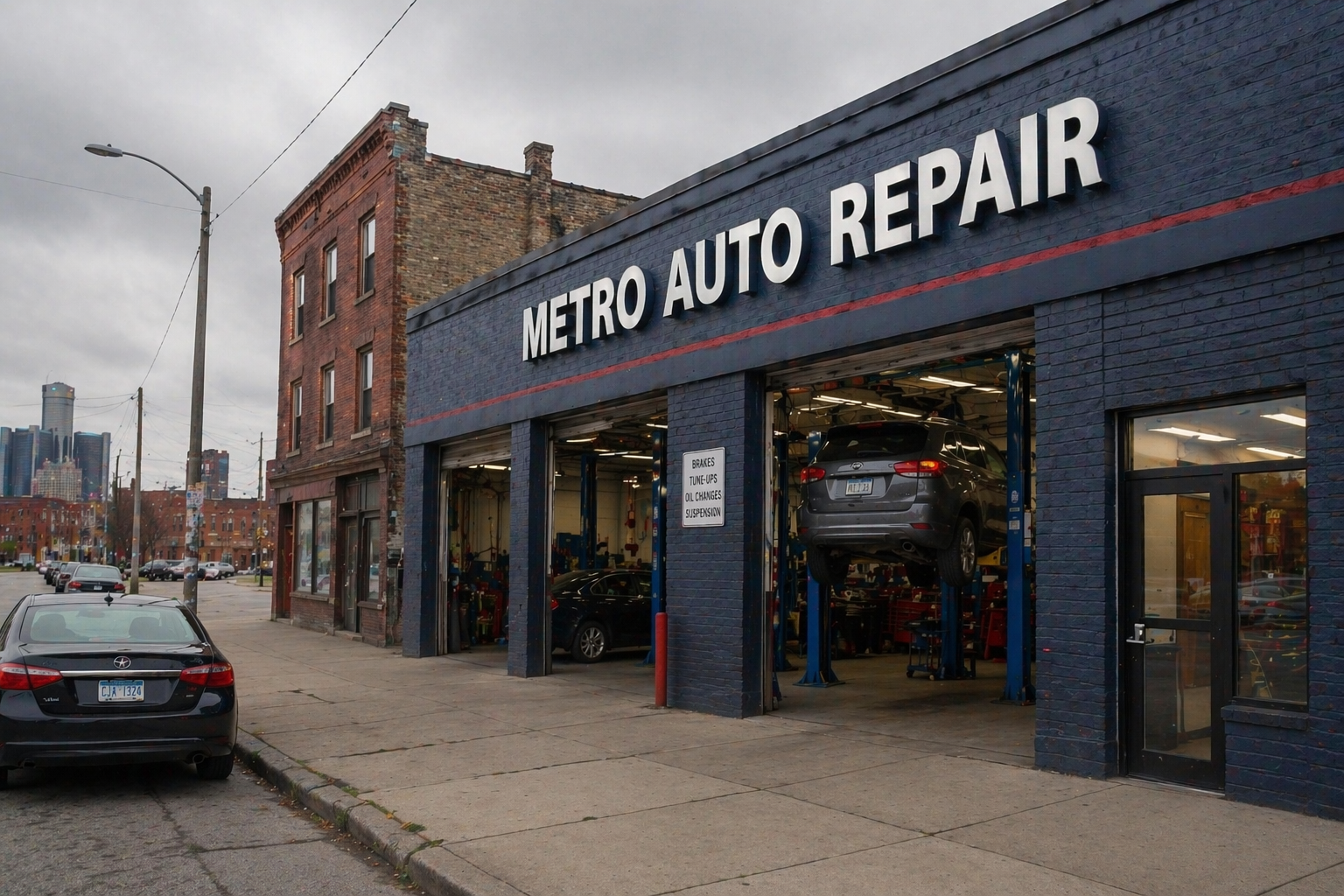
Getting found is step one. Getting the call is step two. Most auto shop websites fail at step two even when they rank decently — because the site doesn't answer the questions a new customer has before they trust a shop they've never used.
The highest-converting auto repair sites answer these questions visually before the visitor reads a word:
- Are they legitimate? — Business name, address, and phone number clearly displayed. Michigan repair facility license number visible.
- Are they any good? — Google review count and star rating above the fold. Real testimonials with names and dates, not generic quotes.
- How long have they been around? — "Serving Detroit since [year]" is a trust anchor. Use it prominently.
- Can I reach them right now? — Click-to-call on every page. Hours displayed with today's hours highlighted.
- Do they handle my specific problem? — Service pages that speak directly to what the customer is experiencing: "check engine light," "brakes grinding," "car won't start."
When all five questions are answered before the visitor has to hunt for them, conversion rates go up significantly. The shop that answers these questions fastest and most clearly gets the call. It's not complicated — it's just execution.
Frequently Asked Questions
How much does a website for an auto repair shop cost in Detroit?
A professionally built auto shop website in Detroit typically runs $2,500–$8,000 for a one-time custom build, or $197–$397/month for an agency retainer model that includes build, hosting, maintenance, and ongoing SEO. The retainer model is usually the better value for independent shops — it keeps the site maintained and optimized over time rather than letting it go stale. See our breakdown of what goes into a high-performing auto repair website for a detailed look at what's included.
How long does it take to rank on Google after a website rebuild?
Most shops see measurable movement in 60–90 days: improved map pack positioning, more Google Business Profile views, and early organic traffic gains. Significant ranking improvements for competitive terms like "auto repair Detroit" typically take 3–5 months of consistent optimization. The timeline shortens when GBP optimization and a review-building system run alongside the website work.
Do I really need separate pages for each service?
Yes, for anything you want to rank for specifically. One general "Services" page cannot rank for "brake repair Detroit," "transmission repair Warren," and "AC recharge Dearborn" simultaneously. Each service-plus-city combination is a separate search query with its own results. Separate pages let you target each one directly.
What's the difference between Google Business Profile and my website?
Your Google Business Profile controls your presence in the map pack — the three listings that appear above organic results for local searches. Your website controls your organic ranking below the map and provides the credibility signals Google uses to evaluate your GBP. They work together. Optimizing one without the other leaves significant ranking potential on the table.
Should I use an online appointment booking system?
A simple appointment request form is the minimum. A full online scheduling system (integrated with tools like Tekmetric or Mitchell) is better if your shop volume supports it. At minimum, capture name, phone, service needed, and preferred time — and make sure those leads are reviewed within the hour during business hours. Leads that don't get a callback within 60 minutes convert at a fraction of the rate of immediate follow-ups.
Caliber Web Studio builds websites for Detroit-area auto repair shops — mobile-first, schema-optimized, with service pages that rank for the searches your customers are actually using. No templates, no WordPress, no disappearing after launch. Call us at (313) 799-2315 or request a free site audit — we'll show you exactly what's holding your current site back and what a new one would look like.
Darrin is the founder of Caliber Web Studio, a Detroit-based web design agency that builds high-performance websites for local businesses across Metro Detroit. He has worked with auto repair shops, contractors, salons, restaurants, and professional service firms — focusing on websites that rank on Google and convert visitors into paying customers. Caliber sites are built on Next.js, optimized for Core Web Vitals, and maintained with ongoing SEO accountability.