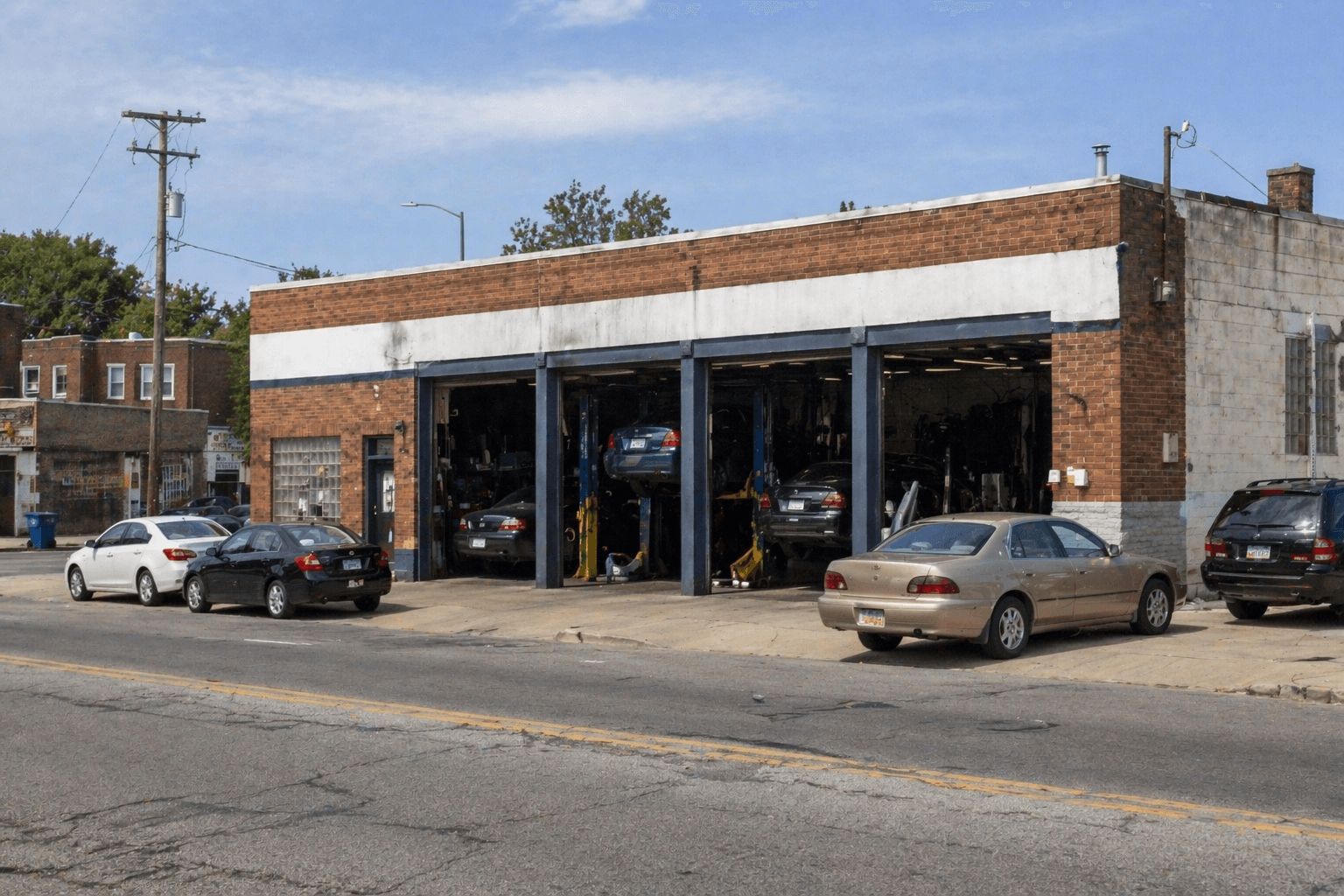
Website Design for Detroit Auto Repair Shops That Actually Brings Customers
Auto repair website design in Detroit works when it does three things: loads fast on a phone, ranks for the searches your customers are actually typing, and makes calling or booking feel effortless. Most Detroit auto shops are losing customers not because their work is bad — it isn't — but because their website doesn't do any of those three things. This guide explains how to fix that.
- Over 80% of people search for auto repair on a mobile phone — your site must load in under 2 seconds
- Generic or template auto shop sites rank poorly; Detroit-specific content is what wins local search
- A click-to-call button, service pages, and real customer reviews are the three highest-ROI elements
- Schema markup (LocalBusiness + Service) tells Google exactly what your shop does and where
- A high-performing auto shop website pays for itself with 2–3 new customers per month
Why Detroit Auto Shops Are Invisible Online — Even With Great Reviews
Here's the frustrating reality most shop owners don't discover until they're already losing business: Google reviews don't rank your website. They help your Google Business Profile — but they do nothing for your website's visibility in search results.
A Detroit auto repair shop can have 200 five-star reviews and still show up on page four of Google because their website is slow, lacks location-specific content, and isn't structured for how search engines read pages. Meanwhile, a shop with 40 reviews but a properly built website sits in the map pack and collects calls all day.
The Detroit market makes this worse. You're not just competing with other independent shops. You're competing with Midas, Firestone, Jiffy Lube, and Pep Boys — all of whom have enterprise SEO teams pushing their sites up the rankings. An independent shop in Warren, Dearborn, or Eastpointe can absolutely outrank them for local searches, but only with a website built specifically to do that job.
The difference isn't luck. It's architecture.
What Auto Repair Website Design in Detroit Actually Requires
Auto shop websites fail for predictable reasons. Here's what separates a site that generates calls from one that sits there burning your hosting dollars.
Mobile-First, Not Mobile-Friendly
There's a difference. "Mobile-friendly" means the site doesn't break on a phone. "Mobile-first" means the entire experience — layout, text size, button placement, load time — was designed starting from the phone screen, not adapted from a desktop version.
When someone's car breaks down or starts making a noise they've never heard before, they pull out their phone immediately. They are not at home on a laptop. They're in a parking lot, at work, or on the side of I-94. If your site takes four seconds to load or has buttons too small to tap with a thumb, you're not in the running. Read our local SEO guide for Detroit small businesses to understand how page speed directly affects your search rankings.
Detroit-Specific Location Signals
A website that says "auto repair" without ever mentioning Warren, Detroit, Hamtramck, or whatever city you're in is invisible to local search. Google needs location signals — in your page titles, headings, meta descriptions, and body copy — to understand that you serve a specific area.
This is why a national template site or a cookie-cutter WordPress theme from a directory company ranks for nothing. The content is generic. It has no geographic identity. It's competing against everything instead of owning the neighborhood where your bays are.
A Real Click-to-Call Flow
Your phone number should be visible without scrolling. It should be a tappable link on mobile (tel: href). It should appear in the header, in the hero section, and ideally in a sticky bar at the bottom of every mobile page. When someone finds you at 7 AM because their car won't start, they are not filling out a contact form. They're looking for a number to tap.
If a visitor has to search for your phone number, you've already lost them.
The 5 Pages Every Detroit Auto Shop Website Must Have
Most auto shop websites have a homepage and a contact page. That's not enough to compete in a market like Metro Detroit, where the difference between showing up and not showing up often comes down to how much content depth Google can find on your site.
1. Homepage — Conversion First, Branding Second
Your homepage headline should state what you do and where you do it: "Detroit Auto Repair — Honest Work, Fair Prices Since 2003." Below that, a clear call to action (call or book), your hours, and your top services. Trust signals — years in business, reviews count, certifications — should be visible before the first scroll.
2. Services Pages — One Per Service
Not one page listing all your services. Individual pages for oil changes, brake repair, engine diagnostics, transmission service, AC service, and any other major service you offer. Each page needs 400–800 words of real content explaining the service, what signs indicate a need for it, what the process looks like, and what it typically costs in Detroit. This is how you rank for "brake repair Warren MI" instead of nothing.
3. About Page — Who You Are and Why It Matters
Independent shops have an enormous trust advantage over chains — if they communicate it. Your about page should tell the real story: who owns the shop, how long you've been in Detroit, what your techs are certified in, why you care about fair pricing. People choose you over Midas because you're a person, not a franchise. Your website should make that obvious.
4. Reviews Page or Embedded Reviews
Pulling your Google reviews into the site — or building a dedicated testimonials page — does two things: it builds trust with visitors, and it gives Google additional proof of your reputation and local activity. Shops that actively collect and display Google reviews convert at significantly higher rates than those that don't.
5. Contact Page With Map Embed and Hours
Your contact page should include a Google Maps embed, your full address, phone number, email, and your hours laid out clearly. This page is also where your LocalBusiness schema markup does heavy lifting — telling Google's crawlers your exact business information in a format they can read without interpretation.
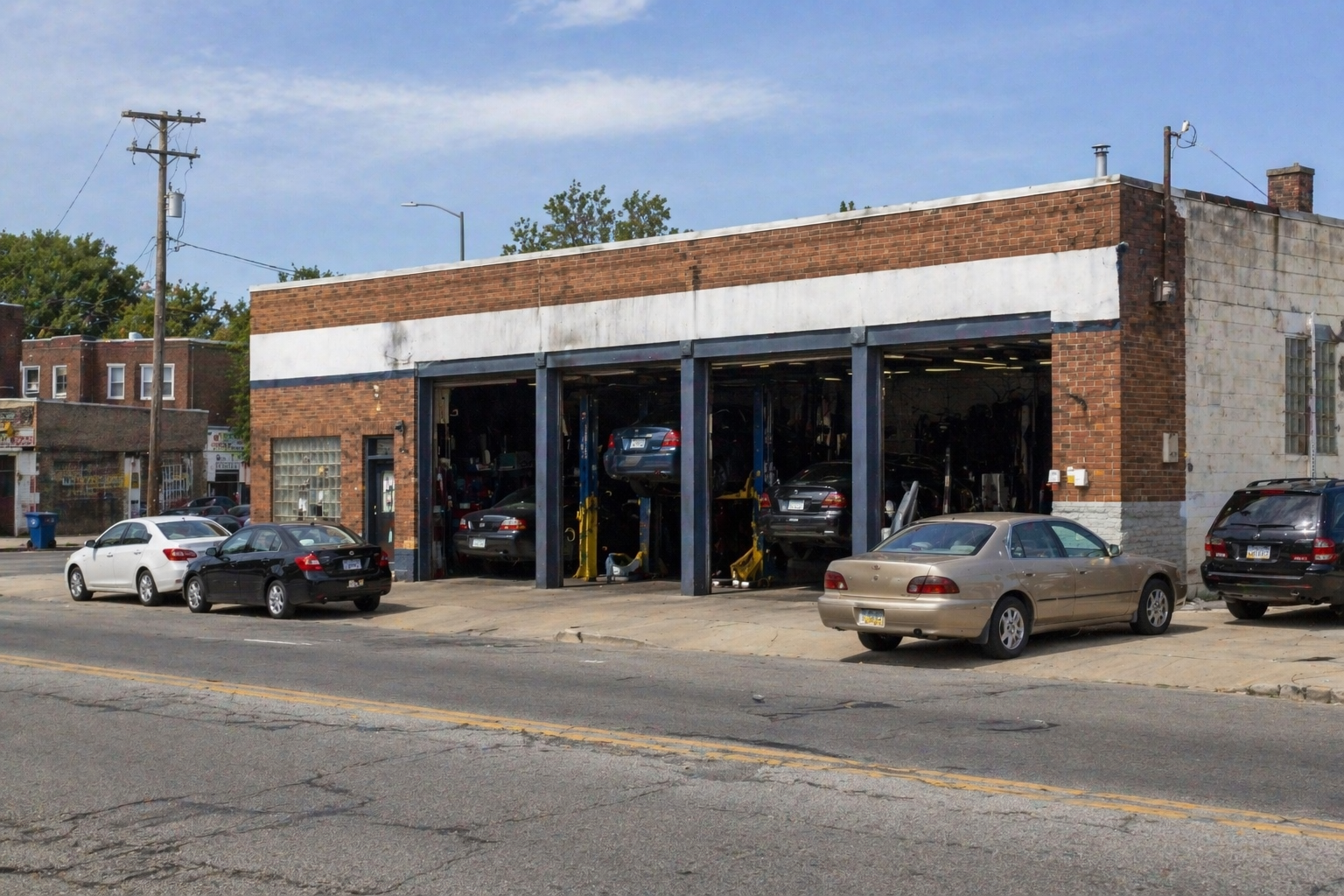
The High-Converting Auto Shop Website Checklist
Use this to evaluate your current site — or to know what to ask for when you hire someone to build a new one.
| Element | Why It Matters | Priority |
|---|---|---|
| Click-to-call in header | Phone calls are the primary conversion goal for auto shops | Critical |
| Mobile sticky call bar | Keeps your number accessible on every page without hunting | Critical |
| Individual service pages | Each page targets a specific search query (e.g., "brake repair Detroit") | High |
| LocalBusiness schema | Tells Google your name, address, hours, and service area precisely | High |
| Google Maps embed | Reduces friction for customers finding your location | High |
| Visible review count and rating | Social proof above the fold increases call conversion rates | High |
| Sub-2-second mobile load time | Core Web Vitals ranking factor; slow sites rank lower and lose visitors | High |
| City name in title tags and H1s | Location signals required for local search visibility | High |
| ASE certifications displayed | Trust signal — reduces hesitation before calling | Medium |
| Online scheduling or quote form | Captures leads after hours when the phone isn't answered | Medium |
What Happens When This Is Done Right: A Detroit-Area Shop Story
An independent auto shop in Warren had 180 Google reviews and a 4.8-star rating. Business was solid but stagnant. New customers were coming almost entirely from referrals. Online, they were invisible — ranking on page three for their own business name and nowhere for any service term.
The problem wasn't their reputation. It was their website: a five-year-old WordPress site built from a template, loading in 6.2 seconds on mobile, with a single "Services" page listing 14 items in bullet points, and zero location-specific content anywhere on the site.
After a rebuild — individual service pages targeting Warren and surrounding cities, LocalBusiness schema, a mobile-first design loading under 1.8 seconds, and reviews embedded above the fold — the results shifted within 90 days. They started ranking in the local map pack for "oil change Warren MI," "brake repair Eastpointe," and "auto repair near me" searches originating from their ZIP code. Monthly new customers from online searches went from 6 to 31. The website paid for itself in the first month.
This is not an unusual outcome. It's what happens when a site is built for the actual job — generating calls — instead of just existing online. Understanding how local SEO works for Detroit service businesses is the first step toward getting these results for your shop.

Schema Markup: The Technical Edge Most Auto Shops Skip
Schema markup is structured data embedded in your website that tells Google exactly what your business is — not in natural language that requires interpretation, but in a precise machine-readable format. For auto repair shops, the right schema can be the difference between appearing in the local map pack and sitting on page two.
What a properly implemented auto shop schema setup includes:
- LocalBusiness schema — Your exact name, address, phone number, service area, hours, and price range
- AutoRepair type — Tells Google you are specifically an auto repair shop, not a generic local business
- Service schema — Individual markup for each service: oil change, brake repair, transmission, etc.
- AggregateRating schema — Pulls your review average and count into Google search results as visible gold stars
- FAQPage schema — Marks up FAQ content for potential rich result display
None of this requires a developer if you're working with a modern framework. But it does require intentional setup — it won't happen automatically with a drag-and-drop website builder. The shops that have it in place have a structural advantage over the shops that don't, and that advantage compounds over time as Google's understanding of their business deepens. Your Google Business Profile and your website schema should tell the exact same story — consistent NAP data, consistent service categories, consistent service area language.
Frequently Asked Questions
How much does a website for a Detroit auto repair shop cost?
A properly built auto shop website — mobile-first, with individual service pages, local SEO, and schema markup — typically runs $1,500–$4,000 for a one-time build, or $150–$250/month on a subscription model that includes hosting, updates, and ongoing optimization. Template directory sites run cheaper but perform significantly worse. The ROI calculation is straightforward: if one new customer per month comes from the website, a $200/month investment pays back in the first week of the month.
How long does it take to rank on Google after a new site launches?
For competitive terms like "auto repair Detroit," expect 3–5 months for meaningful ranking movement. For neighborhood or service-specific terms — "brake repair Warren MI," "oil change near Hamtramck" — results often appear in 6–10 weeks. Shops that pair a new website with active Google Business Profile management and consistent review collection see faster results. Organic search is a compounding investment: the longer a well-built site is live, the stronger it performs.
Do I need separate pages for each service I offer?
Yes, if you want to rank for those services. A single "Services" page listing everything you do ranks for none of it specifically. Each service page — oil changes, brakes, transmission, AC, engine diagnostics — is an opportunity to rank for that exact search term in your city. More pages means more doors into your site from search. For a shop offering 8–12 services, that's 8–12 times the organic search surface area compared to a one-page approach.
My shop has great Google reviews. Why aren't I ranking?
Google reviews boost your Google Business Profile visibility — the map pack results. They have minimal direct impact on your website's ranking in organic search results below the map. For organic rankings, Google evaluates your website's content quality, page speed, mobile experience, schema markup, and backlinks. Many shops with excellent reviews have weak websites and rank poorly because those are two separate systems. Both need attention.
Can I build my own auto shop website on Wix or Squarespace?
You can, but you'll be fighting an uphill battle against shops using higher-performance platforms. Wix and Squarespace sites are generally slower, less flexible for local SEO configuration, and harder to implement proper schema markup on. In a competitive market like Detroit auto repair, those technical disadvantages translate directly into lower rankings. If budget is the constraint, a Caliber Web Studio subscription model — where you get a properly built site for a monthly fee instead of a large upfront cost — is often a better path than a DIY template. See our full auto repair shop website guide for a complete breakdown.
Caliber Web Studio builds auto repair websites for Detroit-area shops — mobile-first, schema-ready, with individual service pages and local SEO built in from day one. No templates. No WordPress. No disappearing after launch. Call us at (313) 799-2315 or request a free site preview — we'll show you what your new site looks like before you spend a dollar.
About the Author: Darrin Singer Jr. is the founder of Caliber Web Studio, a Detroit-based web design agency that builds high-performance websites exclusively for local businesses across Metro Detroit. Darrin has helped dozens of Detroit-area service businesses — auto shops, contractors, restaurants, salons — go from invisible online to ranking on the first page of Google. Every site Caliber builds is custom-coded, mobile-first, and designed to generate real leads, not just traffic.